ROTATING EQUIPMENT RELIABILITY
THE RIGHT SEAL FOR
EVERY STUFFING BOX.
SEPCO – COMPRESSION PACKING & MECHANICAL SEALS
Wrong packing selection costs more than the packing itself. SEPCO engineers the right fiber, coating, and geometry for the specific pressure, temperature, shaft speed, and process fluid — from general-purpose pump packing to API-compliant mechanical seals for refinery service. Kelley Industrial specifies and stocks the full SEPCO line for Midwest refineries, chemical plants, and heavy manufacturers.
Quick Specifications
MANUFACTURER
SEPCO, Inc.
PRODUCT LINES
Compression Packing Mech. Seals
PACKING FIBER
Aramid · PTFE · Graphite · Acrylic
SEALING CONFIGURATIONS
Cartridge · Component · Double
APPLICATIONS
Pumps · Valves · Mixers · Compressors
STANDARDS
API 610 · ISO · ANSI · FDA
CERTIFICATION
ISO 9001 Certified
AUTHORIZED DISTRIBUTOR
Call 440.478.2922
API 610
ISO 9001
ANSI/HI
FDA MATERIALS
NUCLEAR GRADE
ISO
⚠ Pump or valve seal failure on critical unit?
TWO PRODUCT LINES. ONE SOURCE.
PACKING OR MECHANICAL SEAL –
WE SPECIFY THE CORRECT SOLUTION.
PRODUCT LINE 01
COMPRESSION
PACKING
Compression packing controls leakage by radially expanding a set of braided rings against the rotating shaft and stuffing box bore. When correctly selected and installed, it is one of the most reliable and cost-effective shaft sealing methods available — particularly for slurries, abrasive process fluids, and applications where controlled leakage is acceptable and equipment downtime for seal replacement is not.
SEPCO manufactures compression packing in aramid, expanded PTFE, flexible graphite, acrylic, and specialty blended fiber constructions — each engineered for specific pressure, temperature, and chemical compatibility ranges. Every style is available in die-formed rings for pump applications or continuous rope for valve and equipment service.
· PUMP PACKING – CENTRIFUGAL AND RECIPROCATING
· VALVE PACKING – RISING AND ROTATING STEM
· AGITATOR AND MIXER SHAFT PACKING
· HIGH-TEMPERATURE AND CRYOGENIC SERVICE
· CHEMICAL AND ABRASIVE SLURRY APPLICATIONS
· DIE-FORMED RINGS AND CUSTOM CUT SETS AVAILABLE
PRODUCT LINE 02
MECHANICAL
SEALS
Mechanical seals contain shaft leakage at the interface of two precision-lapped seal faces — one rotating, one stationary — perpendicular to the shaft. They eliminate the controlled drip required by compression packing and are the correct choice for zero-leakage, emissions-regulated, and high-speed rotating equipment applications in refinery, chemical, and power generation service.
SEPCO produces cartridge and component seal configurations in single, double, and tandem arrangements. Cartridge designs pre-set critical dimensions, eliminating installation error on pump and mixer applications. Component designs allow field assembly on equipment where cartridge installation geometry is constrained. Both are available in materials and face combinations for API 610 and general process service.
· CARTRIDGE SEALS- SINGLE AND DOUBLE
· COMPONENT SEALS – FIELD ASSEMBLED
· API 610/ API 682 COMLIANT CONFIGURATIONS
· BALANCED SEAL DESIGNS FOR ELEVATED PRESSURE
· GREASE-PURGE SEALS FOR NON-PROCESS-FLUID APPLICATIONS
· SEAL SUPPORT SYSTEM AND FLUSH PLANS
ISO
9001 CERTIFIED MANUFACTURER – QUALITY CONTROLLED FROM FIBER TO FINISHED RING
12+
INDUSTRIES SERVED – FROM REFINERY TO NUCLEAR TO FOOD PROCESSING
API
610 AND 682 COMPLIANT SEAL CONFIGURATIONS FOR CRITICAL ROTATING EQUIPMENT
1 Src
SINGLE SOURCE FOR PACKING, MECHANICAL SEALS, AND SEALING FAILURE ANALYSIS
COMPRESSION PACKING
COMPRESSION PACKING – HOW IT WORKS
RIGHT FIBER.
RIGHT BUILD.
RIGHT PRESSURE.
Packing failure is almost always a selection or installation problem — not a technology limitation. The wrong fiber in the wrong application wears the shaft, hardens prematurely, or permits leakage that no amount of gland adjustment will correct. SEPCO’s packing line starts with the process conditions and works backward to the right fiber construction, ring geometry, and lubrication package.
01
FIBER SELECTION – CHEMISTRY FIRST
SEPCO manufactures compression packing in aramid, expanded PTFE, flexible graphite, acrylic, and blended fiber constructions. Each fiber has a defined operating envelope — pH range, temperature ceiling, shaft speed limit, and abrasion resistance profile. Selecting based on cost alone produces failures. Kelley Industrial maps the process fluid, stuffing box pressure, and shaft speed to the correct SEPCO fiber construction before recommending a style number.
02
BRAID ARCHITECTURE – HOW IT SEALS
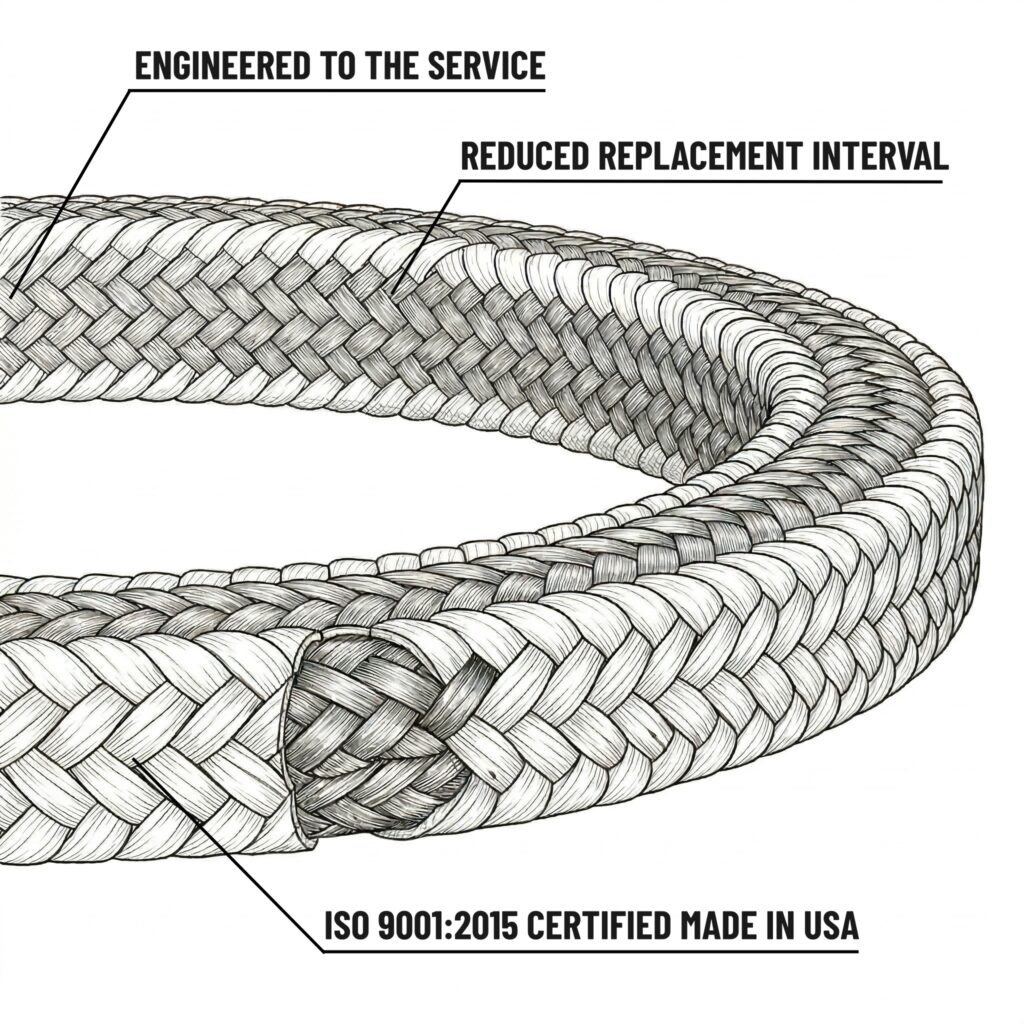
Compression packing seals by radially expanding when the gland follower compresses the ring set axially. Braid geometry determines how evenly pressure distributes across the stuffing box bore and how well the ring conforms to the shaft surface. Braided-throughout constructions distribute load evenly. Corner-reinforced aramid designs resist extrusion under high stuffing box pressure. SEPCO engineers the braid pattern for the specific equipment geometry.
03
PTFE AND LUBRICANT TREATMENTS
SEPCO saturates and coats packing fibers with PTFE particles and inert lubricants to protect against chemical attack and reduce friction at the shaft interface. Untreated packing generates heat, hardens, and scores the shaft — often destroying the stuffing box bore in the process. PTFE-treated SEPCO packing runs cooler, lasts longer, and allows controlled gland adjustment across the full service life without shaft damage.
04
DIE-FORMED RINGS FOR PUMPS
Die-formed packing rings are cut and pressed to exact cross-section dimensions for specific stuffing box geometries. Correctly sized rings install without voids or gaps — the primary cause of premature packing failure on pump applications. SEPCO supplies die-formed rings pre-cut to the pump OEM’s stuffing box dimensions, eliminating field cutting errors and the installation damage that follows. Custom sets are available for non-standard bore and shaft combinations.
Why packing keeps failing on the same pump: Most repeat packing failures trace to three root causes — wrong fiber for the process fluid, incorrect ring size creating gaps on installation, or a scored shaft from a previous failure that no amount of new packing will seal against. SEPCO’s sealing failure analysis service evaluates pulled packing sets and stuffing box condition to identify the root cause. Kelley Industrial can coordinate that evaluation for Midwest customers before the next set is ordered.
COMPRESSION PACKING PRODUCT LINE
BUILT FOR THE PROCESS.
NOT FOR THE SHELF.
SEPCO manufactures compression packing across a full fiber matrix — from general-purpose acrylic for water service to nuclear-grade flexible graphite for high-temperature, high-pressure process applications. Every construction is available in die-formed pump rings, continuous rope, and custom-cut sets.
ACRYLIC · PTFE · GENERAL SERVICE
ML2225 / ML2225A
PTFE-saturated acrylic fiber braided throughout, with the ML2225A adding aramid-reinforced corners for elevated stuffing box pressures. The general-purpose pump and valve packing for water, mild chemicals, and utility service. Wide chemical compatibility and low shaft wear make this the workhorse of the SEPCO packing line.
PUMPS · VALVES · WATER · MILD CHEMICAL · GENERAL SERVICE
ARAMID + PTFE · HIGH PRESSURE
ML4800
Aramid fiber construction with individual strand PTFE treatment and inert oil lubrication. Designed for high-stuffing-box-pressure pump and valve applications where acrylic fiber would extrude through clearances. Handles shaft speeds and pressures that destroy softer packing constructions. The correct specification for high-pressure process pump service.
HIGH PRESSURE · HIGH SPEED · PUMPS · CHEMICAL · REFINERY SERVICE
HIGH TEMP · CHEMICAL RESISTANCE
Flexible Graphite
Expanded flexible graphite packing for high-temperature and chemically aggressive service where polymer-based fibers are outside their operating range. Compatible with most process chemicals, steam, and thermal fluids. Used on gate and globe valves, high-temperature pump service, and equipment where FDA or nuclear qualification is required. Temperature range exceeds 850°F in non-oxidizing service.
HIGH TEMP · STEAM · VALVES · CHEMICAL · NUCLEAR GRADE AVAILABLE
CHEMICAL INERTNESS · LOW FRICTION
Expanded PTFE
Expanded PTFE packing for applications requiring broad chemical inertness, FDA compliance, or extremely low shaft friction. Handles pH extremes that attack both acrylic and graphite packing. Used on pharmaceutical mixing equipment, food-grade pump service, and valve stems where stem torque must be minimized. Expanded structure conforms to irregular stuffing box surfaces without voids.
FDA · CHEMICAL INERT · PHARMA · FOOD · VALVE STEMS
STEM SEALING · GATE · GLOBE · BALL
Valve Packing Sets
SEPCO manufactures valve packing for rising-stem gate and globe valves, rotating-stem ball valves, and quarter-turn applications. Die-formed rings are available to OEM valve dimensions for leak-free installation. Flexible graphite V-ring sets for high-temperature and high-pressure steam valve service. Anti-extrusion rings prevent packing migration under cyclic stem loading.
GATE · GLOBE · BALL · RISING STEAM · HIGH-TEMP STEAM
APPLICATION SPECIFIC · NON-STANDARD BORE
Custom Packing Sets
Non-standard stuffing box bore and shaft combinations are common on older refinery and chemical plant equipment. SEPCO produces custom-dimensioned die-formed rings and cut sets for equipment where standard packing sizes do not fit. Kelley Industrial coordinates dimensional data collection and custom set ordering to eliminate field cutting on critical pump and valve application
CUSTOM DIMENSIONS · OLDER EQUIPMENT · REFINERY · CHEMICAL PLANT
MECHANCIAL SEALS
MECHANICAL SEALS – HOW IT WORKS
ZERO LEAKAGE.
PRECISION FACES.
APPLICATION MATCHED.
Mechanical seals contain shaft leakage at a precision interface between two lapped seal faces — one that rotates with the shaft, one that remains stationary in the gland. When correctly specified for the application pressure, temperature, and process fluid, mechanical seals produce zero visible leakage and run maintenance-free between planned outages. When incorrectly specified, they fail at the faces within weeks.
01
PRIMARY SEAL INTERFACE
The rotary seal ring and stationary seat ring are lapped flat to within light-band tolerances — typically 3 helium light bands across the face. The thin liquid film between the faces lubricates the interface and creates the pressure drop that prevents process fluid from escaping. Face flatness, face load, and liquid film stability determine seal life. SEPCO manufactures seal faces in silicon carbide, tungsten carbide, carbon, and ceramic — matched to the process fluid and operating conditions of the specific application.
02
CARTRIDGE VS. COMPONENT CONFIG.
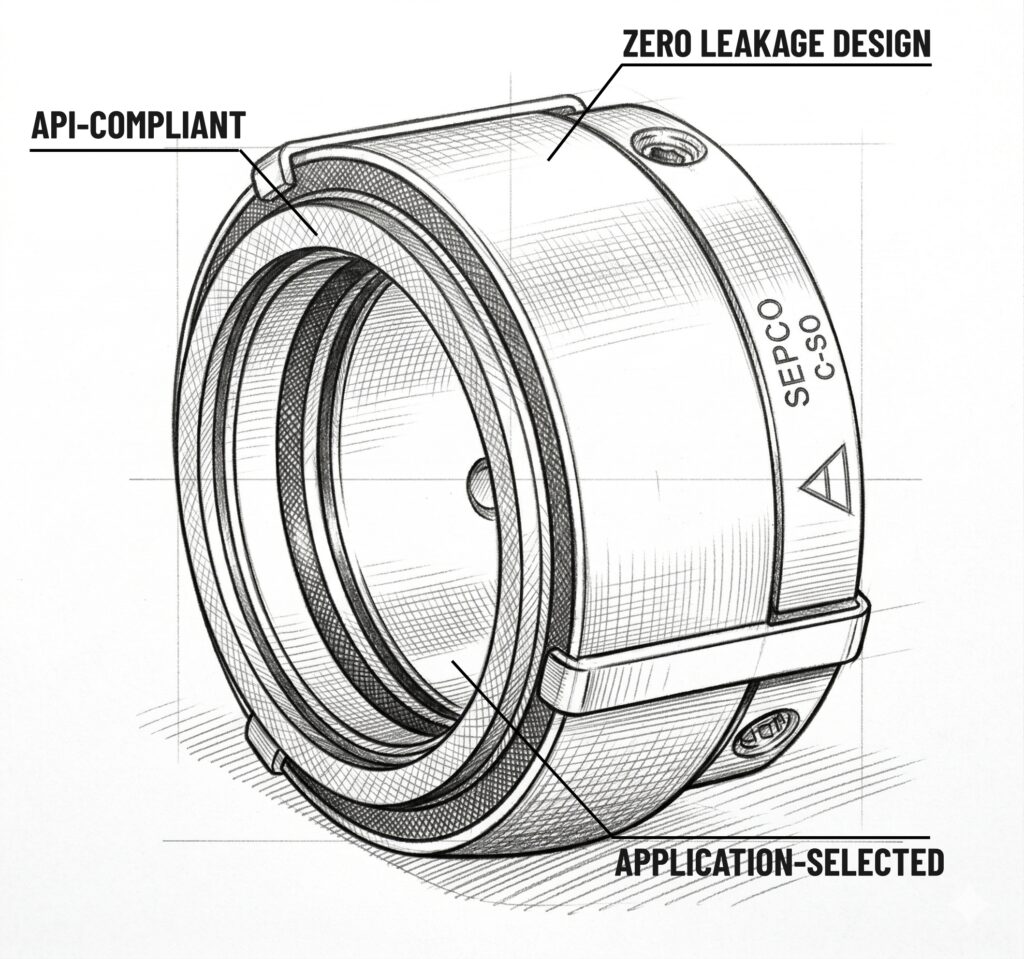
Cartridge seals pre-set all critical dimensions — spring compression, face load, and gland bolt-circle alignment — in a factory-assembled unit that mounts directly to the pump stuffing box. Installation error is the most common cause of early mechanical seal failure. Cartridge designs eliminate it. Component seals assemble in the field from individual elements and are used where cartridge geometry cannot fit the existing equipment. SEPCO produces both; Kelley Industrial recommends based on equipment access and maintenance capability.
03
SINGLE, DOUBLE, AND TANDEM ARRANGEMENTS
Single seals are the standard for most process pump applications where the process fluid provides adequate face lubrication. Double seals — two seal faces with a pressurized barrier fluid between them — are required for hazardous, toxic, or polymerizing process fluids where a single seal failure would release product to the atmosphere. Tandem seals run unpressurized barrier fluid and are used where API 682 requires a containment seal as backup to the primary. Kelley Industrial specifies the correct arrangement based on process conditions and regulatory requirements.
04
BALANCED SEAL DESIGN FOR PRESSURE
Unbalanced seals allow full process pressure to act on the seal face area, generating heat and wear at elevated stuffing box pressures. Balanced seal designs reduce the hydraulic closing force by stepping the shaft sleeve, keeping face load within the operating range of the seal faces across the full pressure envelope. SEPCO’s balanced cartridge seals are the correct specification for API 610 pumps in refinery and petrochemical service, where stuffing box pressures routinely exceed the operating range of unbalanced designs.
Why mechanical seals fail early on process pumps: Three root causes account for the majority of early seal failures — wrong face material for the process fluid, installation damage from component seal assembly, and incorrect flush plan for the stuffing box conditions. A silicon carbide face running dry on a liquid-containing application will fail in hours. Kelley Industrial evaluates the process conditions, specifies the correct face combination and seal configuration, and coordinates flush plan selection before the seal is ordered.
MECHANICAL SEAL PRODUCT LINE
CARTRIDGE. COMPONENT
BUILT FOR THE EQUIPMENT.
SEPCO’s mechanical seal line covers standard pump service through API 682 Plan-compliant configurations for refinery and petrochemical rotating equipment. Kelley Industrial stocks and specifies the line for Midwest customers — cartridge and component, single and double, standard and API service.
BALANCED SINGLE SPRING · CARTRIDGE
BSS
Rotary-designed, balanced, single-spring cartridge seal capable of handling higher stuffing box pressures than conventional unbalanced designs. The workhorse mechanical seal for ANSI and API process pump applications in refinery and chemical service. Factory-preset dimensions eliminate installation error. Available in multiple face and elastomer combinations for broad process compatibility.
BALANCED · CARTRIDGE · ANSI · API · REFINERY · CHEMICAL
GREASE SEAL · SINGLE & DOUBLE
CGS / DGS
Cartridge grease seal designs for applications where a clean process fluid flush is unavailable or impractical. The CGS replaces double mechanical seals on a single cartridge using a grease purge barrier — reducing seal support system complexity. The DGS is a multiple cartridge double design for higher-pressure and more aggressive service requiring continuous grease barrier pressure. Used on mixers, agitators, and pump applications without seal water access.
GREASE PURGE · NO FLUSH REQUIRED · MIXERS · AGITATORS · PUMPS
COMPONENT · FIELD-ASSEMBLED
CSO
Component seal design for applications where cartridge installation geometry is constrained by equipment configuration. The CSO assembles from individual elements in the field and accommodates non-standard stuffing box dimensions on older process pumps and mixers where cartridge seals cannot be directly applied. Available in single and double configurations.
COMPONENT · FIELD ASSEMBLY · NON-STANDARD BORE · OLDER EQUIPMENT
DOUBLE ROTARY CARTRIDGE · DIFFICULT-FIT
DRC
Multiple cartridge mounted rotary seal for equipment where standard cartridge geometry cannot accommodate the seal. Designed for difficult-to-fit equipment configurations in chemical processing and heavy manufacturing. Double-seal arrangement provides containment backup in hazardous process fluid service. Rotary design accommodates shaft runout that would fail stationary designs.
DOUBLE · DIFFICULT FIT · HAZARDOUS FLUID · CHEMICAL · HEAVY MFG
REFINERY SERVICE · PLAN COMPLIANT
API 682 Configurations
SEPCO configures mechanical seals to API 682 Plan requirements for refinery and petrochemical rotating equipment. Plan 11, 13, 21, 23, 32, and 53 flush arrangements are supported depending on the stuffing box conditions and environmental controls required. Kelley Industrial evaluates the process conditions and specifies the correct API Plan before ordering. Seal support systems are available for double-seal installations.
API 682 · PLAN 11/23/32/53 · REFINERY · PETROCHEMICAL
SUPPORT SYSTEMS · FLUSH HARDWARE
SEAL ACCESSORIES
SEPCO’s seal accessory line covers the flush, barrier, and quench hardware required to support mechanical seal installations in regulated and demanding process environments. Throat bushings, seal pots, pressure gauges, and heat exchangers for API Plan compliance. Separator plates and lantern rings for packed stuffing box transitions. Kelley Industrial coordinates accessory specification with seal selection.
FLUSH PLANS · BARRIER POTS · API PLAN HARDWARE · LANTERN RINGS
APPLICATIONS
WHERE SEPCO SEALING PERFORMS
CORE APPLICATION
REFINERY PROCESS PUMPS
Crude, vacuum, FCCU, and hydrocracker process pumps run hot hydrocarbons at elevated stuffing box pressures where packing selection and mechanical seal specification directly affect emissions compliance and maintenance cost. SEPCO’s API 682-compliant cartridge seals and high-pressure aramid packing are the correct specifications for refinery rotating equipment. Kelley Industrial has stocked SEPCO products for Midwest refinery customers since 1997.
CORE APPLICATION
CHEMICAL PROCESS EQUIPMENT
Chemical service demands sealing materials that are chemically inert to the specific process fluid — not generally rated for “chemicals.” SEPCO’s fiber and face material matrix covers corrosive acids, caustics, solvents, and reactive process fluids where generic packing or standard seal faces fail within weeks. Kelley Industrial maps the process chemistry to the correct SEPCO packing style or seal face combination before recommending a product.
APPLICATION
VALVE STEM SEALING
Gate, globe, and control valves on high-temperature steam lines and process service require packing that maintains sealing integrity through thousands of stem cycles and significant temperature excursions. SEPCO flexible graphite V-ring sets handle steam service to 850°F. PTFE and acrylic blends address rotating ball and plug valve applications. Die-formed rings to OEM valve dimensions prevent the installation gaps that produce early packing failure.
APPLICATION
MIXER AND AGITATOR SHAFTS
Mixer and agitator shaft sealing presents the same misalignment challenges as agitator processes described elsewhere — but where the Air Mizer is not selected, SEPCO compression packing and grease-purge mechanical seals are the proven alternatives. SEPCO CGS cartridge grease seals eliminate the need for process fluid flush on mixer shafts, reducing seal support complexity on applications without clean liquid access.
APPLICATION
POWER GENERATION
Boiler feed pumps, condensate pumps, and cooling tower systems in power generation require sealing that performs reliably across extended run cycles between planned outages. SEPCO’s balanced cartridge seals and nuclear-grade flexible graphite packing address both conventional and nuclear power generation service. Kelley Industrial supports power generation customers with stocked SEPCO products and application engineering for seal selection on critical BFP service.
APPLICATION
WATER & WASTEWATER
Municipal water and wastewater pumping equipment runs continuously on abrasive, grit-laden fluids that destroy standard packing and produce rapid seal face wear on improperly specified mechanical seals. SEPCO acrylic-PTFE packing with aramid corners handles abrasive water service. SEPCO’s silicon carbide face seals resist the grit damage that destroys softer face materials in raw water and sewage pump applications.
FAILURE ANALYSIS
SEPCO evaluates pulled packing sets and failed mechanical seals to identify root cause — wrong fiber, installation damage, or operating condition mismatch. Kelley Industrial coordinates this service for Midwest customers before the next seal or packing set is ordered.
PLANT EQUIPMENT SURVEY
SEPCO’s plant equipment survey documents every pump, valve, and mixer sealing application across a facility and builds a standardized packing and seal specification list. Eliminates field improvisation and reduces sealing SKU count.
APPLICATION ENGINEERING
SEPCO’s engineering team supports custom seal design and packing specification for non-standard equipment. Kelley Industrial coordinates application engineering for Midwest customers where catalog products do not directly apply to the equipment.
SAMS PROGRAM
SEPCO’s Sealing Application Management System creates a plant-wide sealing specification database, tracking packing and seal performance across equipment tags. Enables proactive sealing management rather than reactive failure response.
IF YOU EQUIPMENT IS LEAKING PRODUCT, THERE IS A FIX.
Product loss from mixer and agitator shaft seals, bearing failures on motors and drives in washdown environments, packing that won’t hold on food-grade pumps — we have solved these problems in food processing facilities before. Tell us what’s happening and we’ll evaluate your application.
Bearing isolators, turnaround safety, and custom-engineered sealing for high-risk industrial operations in the midwest
CONTACT
Kelley Industrial Sales, Inc is based in Cleveland, Ohio.